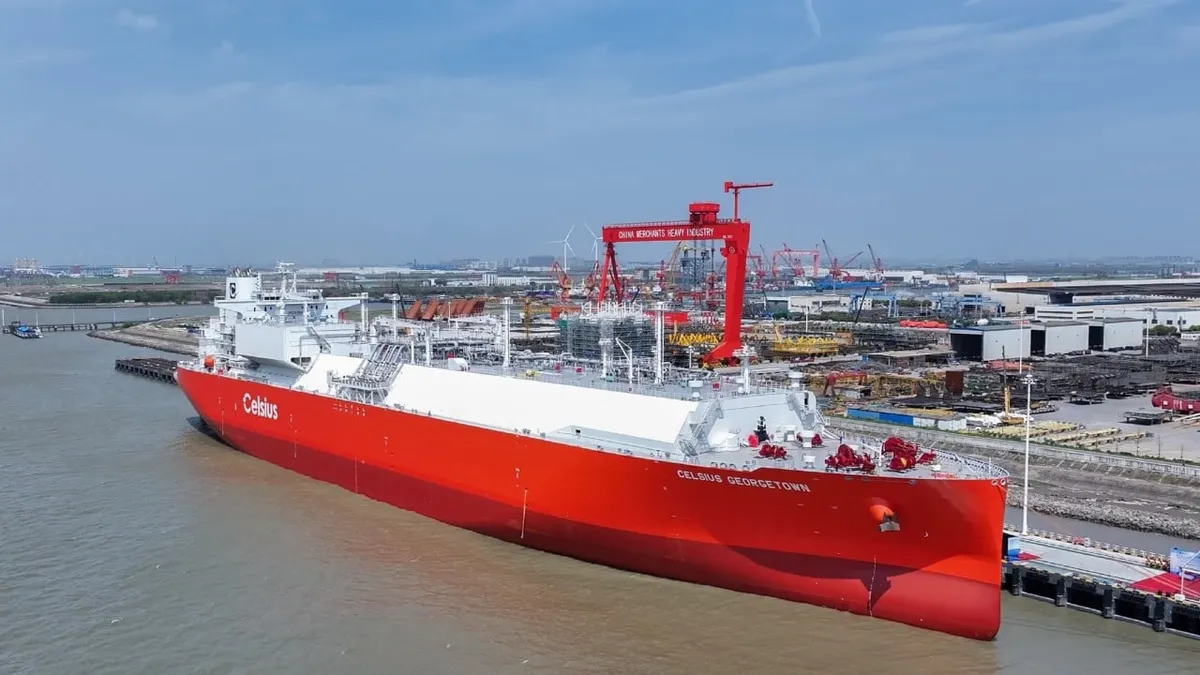
China has delivered its largest liquefied natural gas carrier to date, marking a significant step in the country's push to challenge South Korea's long-standing dominance in one of shipbuilding's most technically demanding and lucrative segments.
China Merchants Heavy Industry (Jiangsu), a subsidiary of state-backed China Merchants Group, completed delivery of the 180,000-cubic-metre vessel, according to reporting by the South China Morning Post. The milestone brings to five the total number of Chinese shipyards now capable of independently designing and constructing LNG carriers of this class.
A high-value frontier
LNG carriers are among the most complex commercial vessels in the world, requiring advanced cryogenic insulation systems to store liquefied natural gas at temperatures around -162 degrees Celsius. Their construction demands precision engineering and significant capital investment, factors that have historically kept the market concentrated in the hands of South Korean builders such as Hyundai Heavy Industries, Samsung Heavy Industries, and Daewoo Shipbuilding and Marine Engineering.
South Korea has maintained a commanding position in LNG carrier construction for decades, benefiting from deep industrial expertise and established relationships with major energy companies. China's expansion into this segment represents a direct competitive challenge to that position.
Broader shipbuilding competition
The delivery comes amid a wider intensification of shipbuilding rivalry between the two nations. China has already surpassed South Korea in overall shipbuilding volume in recent years, driven by lower labor costs and strong state support for its maritime industries. However, high-specification vessels such as LNG carriers have remained an area where South Korean yards retained a technological edge.
The addition of China Merchants Heavy Industry (Jiangsu) to the roster of qualified Chinese LNG shipbuilders signals that Beijing is investing in closing that gap. Having five domestic yards capable of producing such vessels increases China's capacity and competitive flexibility in bidding for future orders.
Energy security dimensions
The development also carries strategic implications beyond commercial competition. China is the world's largest importer of LNG, and building a domestic capacity to construct the vessels that transport the fuel reduces the country's reliance on foreign shipyards for a supply chain critical to its energy security.
As global demand for LNG is expected to grow in the coming decades, particularly as countries seek alternatives to coal and pipeline gas, competition for LNG carrier orders is likely to intensify further between Chinese and South Korean shipbuilders.