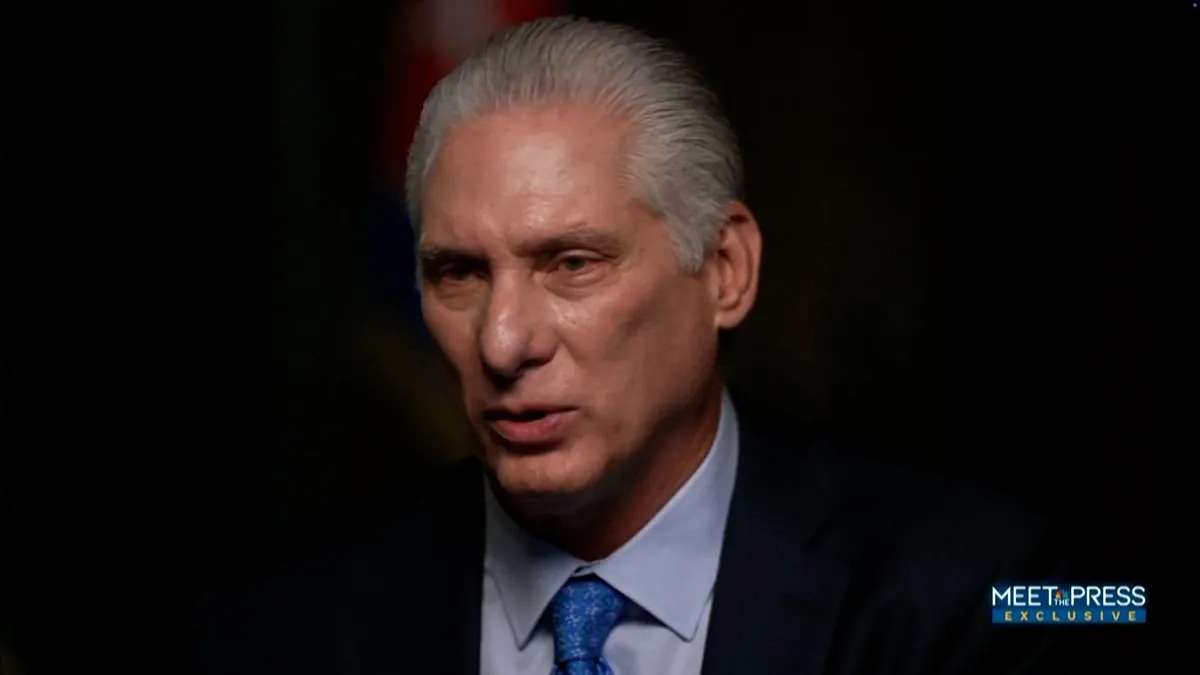
Cuban President Miguel Diaz-Canel has rejected calls to step down, responding defiantly to mounting pressure from the United States and comments by President Donald Trump suggesting Cuba was next in line for American intervention.
Trump had reportedly signaled that Cuba would be a target following a period of heightened US foreign policy assertiveness in the Western Hemisphere. The remarks prompted a direct response from Havana, with Diaz-Canel making clear he has no intention of relinquishing power.
A direct rebuke from Havana
According to reporting by Sky News, the Cuban leader pushed back firmly against what he characterized as external pressure designed to destabilize his government. Diaz-Canel's message was aimed squarely at Washington, framing the US posture as an continuation of decades of American hostility toward the island's communist government.
Cuba has long been subject to a US economic embargo that dates back to the early 1960s. Relations between the two countries briefly thawed during the Obama administration but deteriorated sharply under Trump's first term, a trajectory that appears to be resuming under his second.
Broader regional context
Trump's comments about Cuba come amid a broader pattern of assertive US rhetoric toward countries in the Western Hemisphere. The administration has previously made pointed statements about several nations in the region, signaling a more confrontational approach to governments it considers adversarial.
Cuba, along with Venezuela and Nicaragua, has frequently been cited by US officials as part of a bloc of authoritarian governments in Latin America that Washington seeks to challenge.
Cuba's government has faced significant internal pressures in recent years, including widespread power outages, food shortages, and a wave of emigration that has seen hundreds of thousands of Cubans leave the island. Large-scale protests erupted in 2021, drawing international attention to the population's frustrations with living conditions.
Tensions unlikely to ease
The exchange of statements between Washington and Havana signals that tensions between the two governments are likely to intensify. Diplomatic relations, which were restored under President Barack Obama, were not fully normalized, and the underlying disputes over Cuba's political system and the US embargo remain unresolved.
Diaz-Canel's public refusal to bow to US pressure follows a long-standing pattern in which Cuban leadership has framed American pressure as imperialism, a message that continues to resonate with parts of the domestic audience even as economic hardship grows.
Sky News reported that the Cuban president's remarks were a direct response to Trump's stated intentions, though the precise form any US action might take remains unclear.