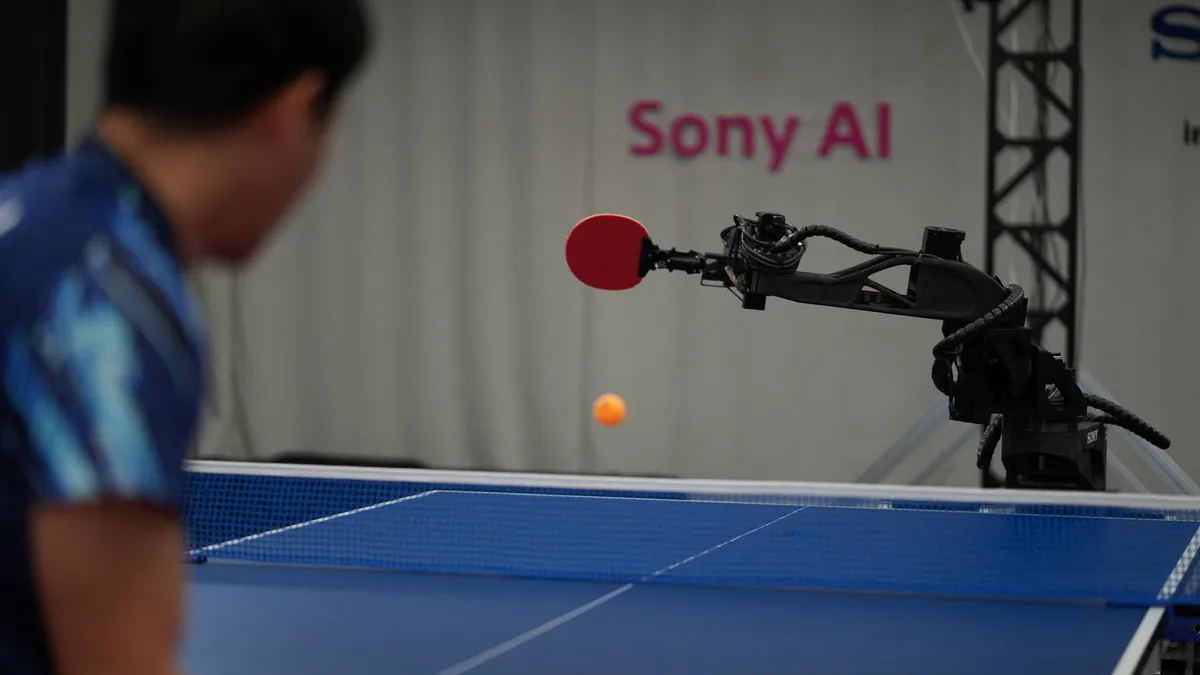
A robot developed by Google DeepMind has reached a level of skill in table tennis capable of defeating elite human players, marking what researchers are calling a significant milestone in the development of artificial intelligence applied to physical tasks.
The robot, which uses a robotic arm mounted in front of a standard table tennis table, was tested against a range of human opponents - from beginners to advanced competitive players. According to reporting by Sky News, the system won all of its matches against novice and intermediate players and, notably, claimed victories against some elite-level competitors as well.
How the system works
The robot relies on a combination of computer vision and machine learning to track the ball, anticipate its trajectory, and execute return shots in real time. It was trained first in simulation and then refined through matches against human players, allowing it to develop strategies for a variety of playing styles.
Researchers noted the system is capable of adapting mid-match, adjusting its technique based on how an opponent is playing - a capability that distinguishes it from earlier, more rigid automated systems.
Limitations remain
Despite the headline results, the robot did not defeat the most highly ranked professional players it faced. Top-level competitors were able to exploit weaknesses in the system, particularly through unpredictable spin and placement. The research team acknowledged these limitations openly, framing the current achievement as a step on a longer development path rather than a definitive triumph over human skill.
The robot also operates in a controlled environment and is fixed in place, meaning it cannot move around the table as human players do - a significant physical constraint that limits direct comparison with the full scope of human table tennis ability.
Broader significance
The development is being closely watched in the AI research community not primarily for its sporting implications, but for what it demonstrates about the capacity of AI systems to operate effectively in fast-moving, unpredictable physical environments.
Table tennis presents a particular challenge for robotics due to the speed of play, the variety of spin that can be applied to the ball, and the need for split-second decision-making. Successfully competing at a high level in such an environment is considered a meaningful test of real-world AI capability.
The findings were published in a research paper and have drawn considerable attention as an indicator of how quickly AI-driven robotics is advancing beyond controlled industrial settings and into domains requiring dynamic, reactive physical performance.