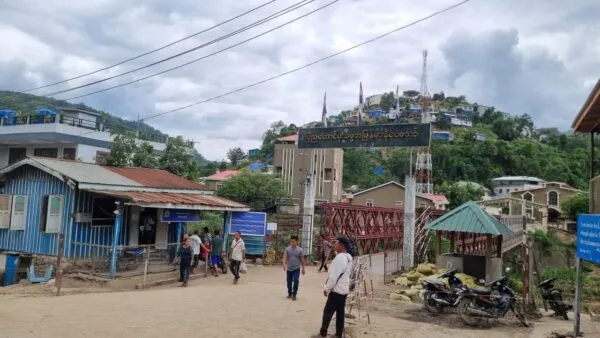
The India-Myanmar border in India's northeast is frequently discussed by officials and analysts as though it is a clearly established and continuously marked boundary requiring only enforcement. According to an analysis published in The Diplomat, that assumption is fundamentally incorrect.
The piece argues that the border is widely misread - treated in public discourse and policy circles as a completed line when, in practice, significant portions remain undefined, disputed, or unmapped on the ground.
A boundary that exists more on paper than in practice
The analysis draws a distinction between the legal or cartographic existence of a border and its physical reality. In much of the rugged, forested terrain of India's northeast states - including Manipur, Nagaland, and Mizoram - the boundary has not been fully surveyed, physically marked, or agreed upon at the local level.
Communities on both sides of the frontier have historically maintained cross-border ties based on ethnicity, trade, and family connections, often with little regard for where the official line falls. This social reality complicates straightforward enforcement-based approaches to border management.
Policy implications
India has in recent years moved to fence portions of the border and tighten the Free Movement Regime, a longstanding arrangement that allowed residents of border communities to cross without formal documentation. The government has framed these measures as responses to security concerns, including insurgent movement and illegal migration.
The Diplomat's analysis suggests that such measures may be proceeding from a flawed premise - that the border is already a coherent, enforceable line. Treating it as such, the piece contends, risks generating friction with local populations and neighboring Myanmar without necessarily achieving the intended security outcomes.
A contested frontier in a volatile region
The border region has grown increasingly complex following Myanmar's military coup in February 2021, which triggered armed conflict and large-scale displacement. Thousands of Myanmar nationals have crossed into India's northeast, prompting debates within the Indian government about refugee policy and border control.
The unresolved nature of portions of the boundary adds another layer of difficulty to managing these population movements and to India's broader strategic posture in a region bordered by China to the north.
The Diplomat's assessment underscores that effective policy in the region will require a clearer understanding of what the border actually is - not merely what it is assumed to be.