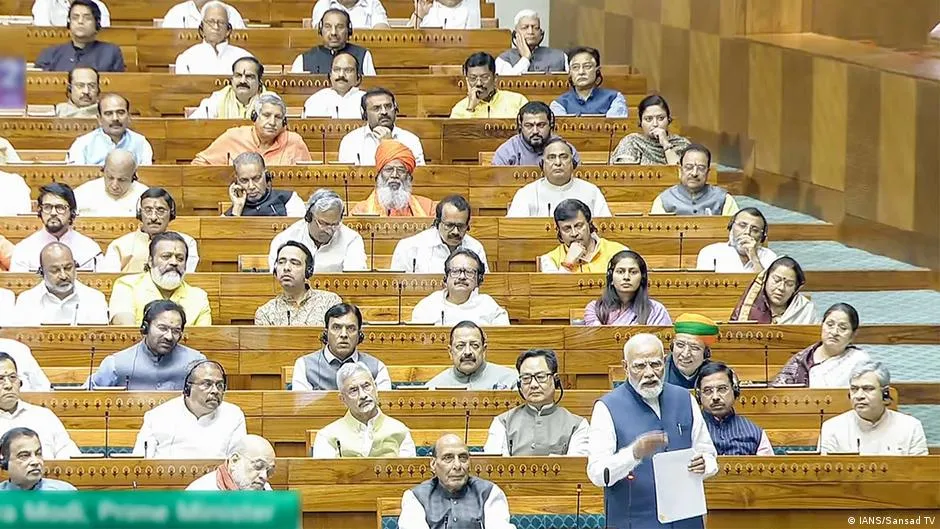
India's parliament has rejected a government-backed bill that would have reserved a portion of legislative seats for women, marking the first significant legislative defeat for Prime Minister Narendra Modi's administration, according to reporting by Deutsche Welle.
The bill's failure came after an outcry over a provision tying the implementation of the women's quota to a delimitation process - the redrawing of India's electoral constituency boundaries. Critics argued the linkage would effectively delay any meaningful representation gains for women by years, as delimitation exercises are lengthy and complex undertakings.
What the bill proposed
The legislation sought to introduce reserved seats for women within India's parliament and state legislatures. Quotas for women in elected office have long been debated in India, with advocates arguing that guaranteed representation is necessary to address the country's historically low levels of female participation in national politics.
However, the government's decision to tie the quota's activation to the completion of a national delimitation exercise drew sharp criticism from opposition parties and some ruling coalition members, who viewed the condition as a mechanism that would postpone actual implementation indefinitely.
A rare setback for Modi
The bill's failure is notable given that Modi's Bharatiya Janata Party-led coalition has generally commanded a working majority in parliament. DW described the vote as the first major legislative setback of Modi's current government, signaling that internal coalition tensions or opposition pressure can still produce unexpected outcomes in the chamber.
India has historically struggled with low representation of women in its national legislature. Female lawmakers make up a relatively small share of seats in the Lok Sabha, the lower house of parliament, placing India behind many of its regional peers on measures of political gender parity.
Reactions and next steps
The outcome of the vote reflects ongoing disagreement over the best mechanism for improving gender representation in Indian politics. Supporters of a clean, unconditional quota argue that attaching preconditions undermines the reform's intent. Government officials have not immediately indicated whether they plan to revise or reintroduce the legislation.
The delimitation question itself carries significant political weight in India, as any redrawing of constituency boundaries affects the distribution of electoral power among states, parties, and demographic groups - adding another layer of controversy to an already contentious debate.