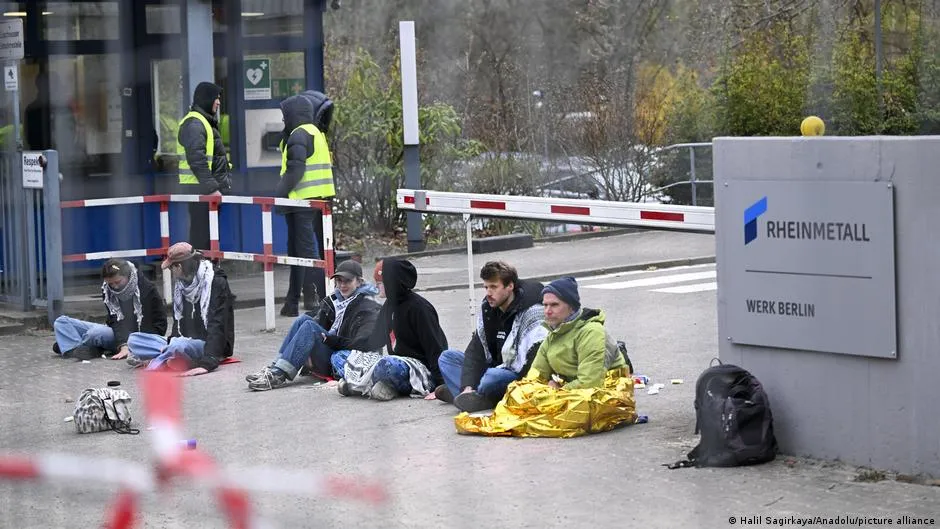
German police removed pro-Palestinian demonstrators who had glued themselves to the entrance of a Rheinmetall arms factory in Berlin, according to reporting by Deutsche Welle. The protest targeted one of Germany's largest defense manufacturers amid ongoing debate over weapons exports to conflict zones.
Officers were called to the scene after activists blocked access to the facility, disrupting operations at the plant. Authorities physically removed the protesters after they adhered themselves to the entrance, a tactic increasingly used by activist groups across Europe to force prolonged police responses and maximize media attention.
Rheinmetall is one of Europe's leading defense and ammunition producers and has seen a sharp rise in orders and public profile since Russia's full-scale invasion of Ukraine in 2022. The company has become a focal point for activist groups opposed to arms sales linked to conflicts in the Middle East.
Inflation edges back up
Separately, new economic data out of Germany indicates that inflation is moving higher again, complicating what had been a cautiously optimistic outlook for price stability in Europe's largest economy.
Deutsche Welle reported that the uptick is being linked in part to the broader economic disruption stemming from the conflict involving Iran, which has unsettled energy markets and global supply chains. Earlier expectations that inflation had been brought under control are now being revised.
Germany, like much of the eurozone, had seen inflation cool significantly from its post-pandemic and post-Ukraine invasion peaks. However, renewed instability in the Middle East has introduced fresh uncertainty into energy prices, which remain a key driver of consumer price movements across the continent.
The European Central Bank has been closely monitoring inflation trends across member states as it weighs decisions on interest rates. A sustained reversal in Germany's inflation trajectory could influence the ECB's policy direction in the months ahead.
Context
The two developments reflect the degree to which global conflicts are shaping daily life in Germany - from street-level protests over defense industry activity to macroeconomic pressure on household budgets.
Germany has faced recurring domestic debates over its role as an arms exporter, particularly since the Gaza conflict intensified. Critics have called for restrictions on weapons that could reach conflict zones, while government officials and defense industry representatives argue that maintaining a robust defense industrial base is essential to European security.
Deutsche Welle is the German public broadcaster and provided the primary reporting on both developments.