Here is a fun new development in a war that has been decidedly short on fun developments: Russia actually lost ground in Ukraine last month. Like, measurable, mapworthy, somebody-is-going-to-get-yelled-at-in-Moscow ground.
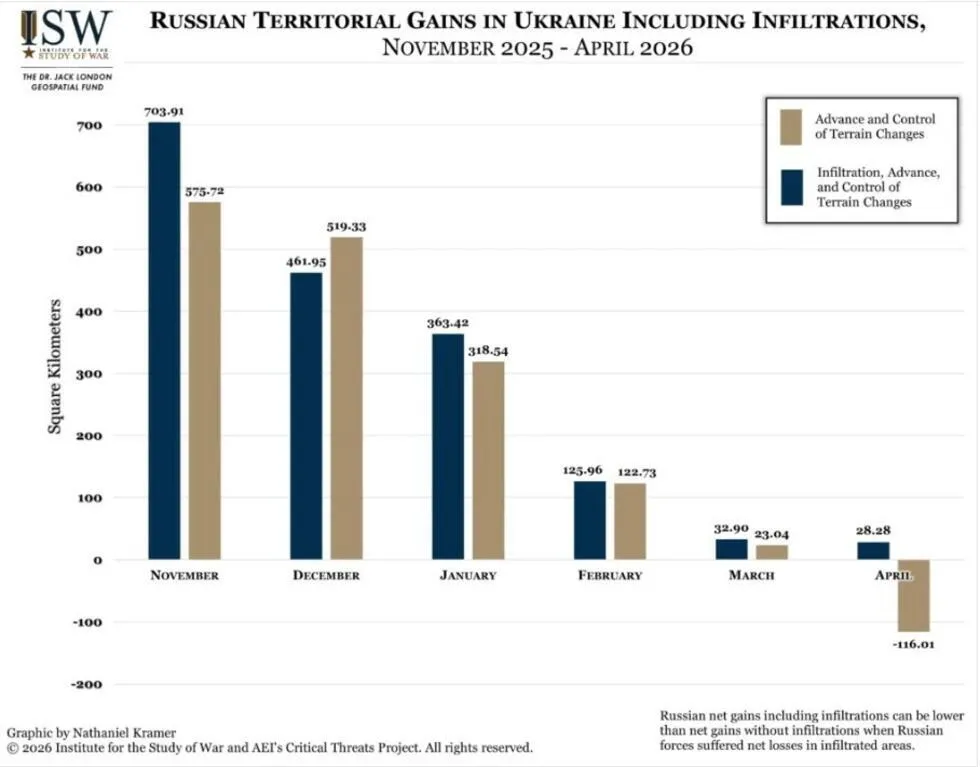
According to an analysis cited by France24, referencing work from the Institute for the Study of War (ISW), April 2026 marked the first time Russia ceded territory on the battlefield since Ukraine's audacious August 2024 incursion into Russia's Kursk oblast. The losses totalled approximately 116 square kilometres spread across multiple sections of the front line - not a catastrophic collapse, but a notable reversal for a military that has spent most of the past year grinding forward, however slowly.
Why this actually matters
To put 116 km² into perspective: that is roughly the size of Paris proper, or about 45 square miles of land that Moscow had been holding and no longer does. In a conflict where territorial shifts are sometimes measured in city blocks and hedgerows, that is a meaningful number.
The last time anything like this happened was during Ukraine's surprise cross-border raid into Kursk Oblast back in August 2024 - a move that briefly made the world's jaws drop and then prompted Russia to spend months clawing back what it lost. Ukraine's forces have since been pushed back from Kursk, making April's losses on Ukrainian soil all the more significant as a data point.
But hold on - war is not a video game scoreboard
Analysts are being appropriately cautious about reading too much into one month's numbers. The ISW and similar research bodies have consistently warned that territorial gains and losses are just one dimension of a conflict this complex. Russia still holds substantial portions of eastern and southern Ukraine, continues to launch large-scale drone and missile attacks on Ukrainian cities, and has shown no sign of softening its stated war aims.
In other words: yes, the front line moved. No, the war is not over. This is very much a "the patient sneezed, which is progress, but they are still in the ICU" kind of situation.
What to watch next
Whether April's losses represent a genuine shift in momentum or just a bumpy month for Russian logistics and command decisions remains to be seen. Military analysts will be watching May's territorial data closely to determine whether this is a trend or a blip. Ukraine, for its part, presumably hopes very much it is the former.
Either way, for the first time in a long time, the map moved in a direction that is not terrible news for Kyiv - and in this war, that alone qualifies as headline-worthy.