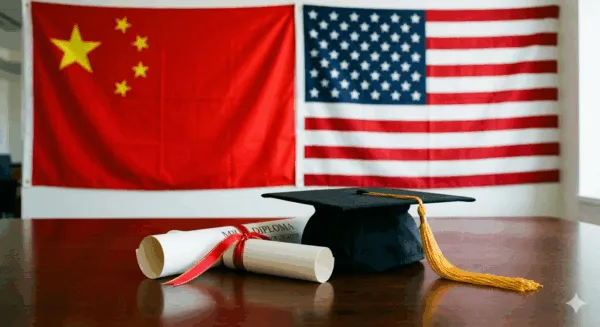
If you ever wanted to feel unwelcome in two countries simultaneously, apparently the move is to be a Chinese Christian student studying in the United States. According to a report by The Diplomat, a growing number of Chinese nationals who come to America seeking academic freedom and, in some cases, religious freedom, are finding themselves sandwiched between two governments that are each, for very different reasons, deeply suspicious of them.
The irony is almost too much
China, as is well documented, maintains a deeply uncomfortable relationship with Christianity and other religions it cannot fully control. Underground churches, state-approved worship, restricted Bibles - the pressure on Chinese Christians from their own government is real and well-reported. So for some, a student visa to the U.S. is not just an academic opportunity, it is a genuine escape valve.
Except America, in its current political mood, is not exactly rolling out the welcome mat. The Diplomat's reporting highlights how Chinese students - regardless of their personal beliefs, political views, or reasons for being here - are increasingly viewed through the lens of national security suspicion. They are seen not as individuals fleeing restrictions, but as potential vectors of Chinese government influence.
Two fears, zero nuance
The situation is a masterclass in how geopolitics flattens human complexity into useless categories. Beijing sees a Christian and worries about ideological contamination from the West. Washington sees a Chinese passport and worries about espionage. The actual person standing between these two paranoid superpowers - who just wanted to attend church and get a degree - barely registers.
The Diplomat's piece frames this as part of a broader pattern where U.S.-China tensions are increasingly playing out on the backs of ordinary people who don't fit neatly into either government's preferred narrative. The open arms that once characterized American academic culture toward international students have, for Chinese nationals in particular, been replaced by bureaucratic friction, visa uncertainty, and social suspicion.
What gets lost in the crossfire
Beyond the geopolitical chess game, this story is a reminder that real human beings live inside statistics about bilateral relations. Someone who crossed oceans partly to worship freely is now discovering that freedom of religion does not automatically come with freedom from profiling.
It is, to put it bluntly, a deeply awkward situation to be a walking Venn diagram of everything both superpowers are currently freaking out about - and a useful reminder that when giants argue, the people standing between them tend to get stepped on.