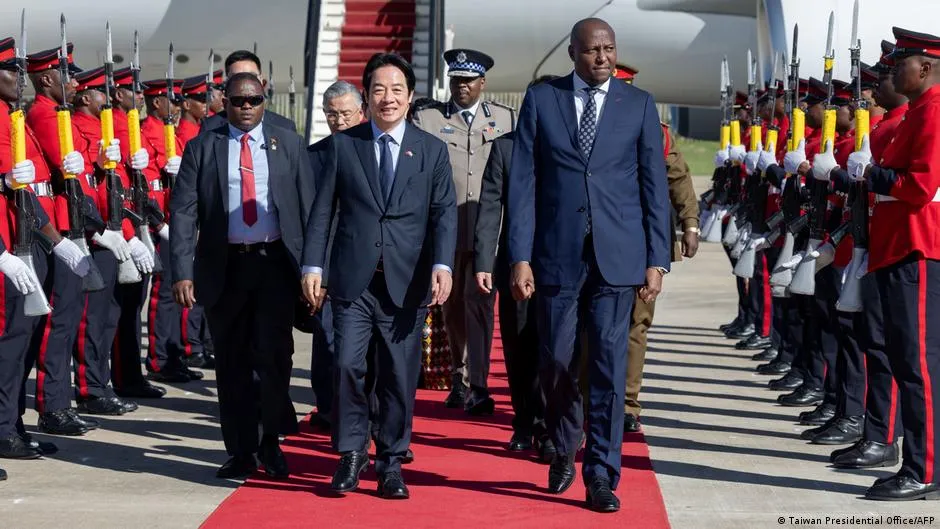
Taiwan's President Lai Ching-te has arrived in Eswatini for an official visit, completing a trip that was complicated by what officials described as Chinese diplomatic pressure on countries along the planned flight route.
Several nations reportedly withdrew permission for Taiwan's presidential aircraft to pass through their airspace, forcing a delay in the visit, according to reporting by Deutsche Welle. The disruptions were attributed to pressure from Beijing, which considers Taiwan a breakaway province and seeks to limit the island's international standing.
Eswatini, the small landlocked southern African kingdom formerly known as Swaziland, remains Taiwan's only formal diplomatic partner on the African continent. The two governments have maintained official ties for decades, making state visits between their leaders a significant marker of the relationship's durability.
Beijing's objection
China routinely objects to any official travel by Taiwanese leaders that could be interpreted as conferring legitimacy on what Beijing views as a separatist government. The reported efforts to deny overflight permissions represent an extension of that pressure into the logistical realm, going beyond typical diplomatic protests.
Beijing has worked steadily over the years to reduce the number of countries that maintain formal diplomatic ties with Taipei. Taiwan currently holds official relations with fewer than a dozen states globally, a number that has declined as China has used economic incentives and diplomatic leverage to persuade governments to switch recognition.
Taiwan's diplomatic position
For Lai, who took office in May 2024 and has maintained a firm stance on Taiwan's distinct identity, the visit to Eswatini carries symbolic weight. Preserving and demonstrating the remaining formal alliances is considered an important element of Taipei's broader effort to sustain international visibility.
The overflight difficulties highlight the practical constraints Taiwan faces even in conducting routine diplomacy. Presidential travel requires cooperation from multiple governments simply to reach a destination, giving Beijing leverage at each step of a journey.
Taiwan's government has not publicly detailed which countries denied overflight access or how the revised route was ultimately arranged. The trip proceeded after the delays, with Lai completing the journey to Mbabane, Eswatini's capital.
China has not issued a specific public statement on the overflight matter as of the time of reporting, though its broader opposition to the visit aligns with longstanding policy objections to any official contact between foreign governments and Taiwanese leaders.