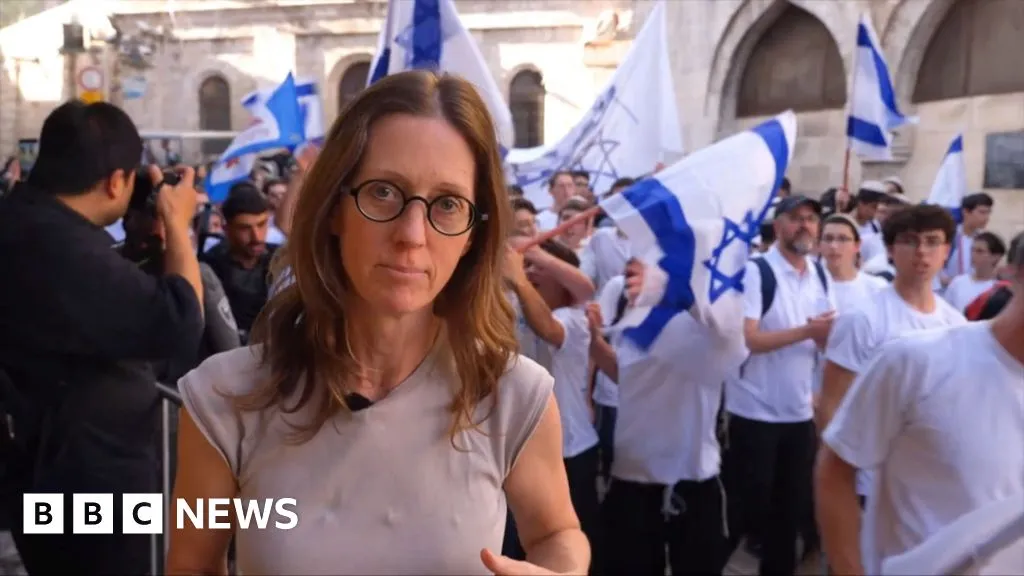
If you were looking for a quiet Tuesday in the Middle East, wrong continent, wrong century, wrong universe. Tens of thousands of Israeli celebrants took to the ancient stone streets of Jerusalem's Old City this week for the annual Jerusalem Day flag march, an event that marks Israel's capture of East Jerusalem during the 1967 Arab-Israeli war - a conflict that, depending on who you ask, either ended 58 years ago or never really ended at all.
BBC journalists were on the ground documenting the march as it wound through the Old City, capturing footage of a crowd that was, by any metric, enormous. The march is an annual tradition that carries enormous symbolic weight for Israeli nationalists, commemorating what Israel considers the reunification of its capital.

So what's the big deal, you ask?
The short answer: everything. The Old City of Jerusalem sits at the intersection of Jewish, Muslim, and Christian holy sites, crammed into a few square kilometers of very old stone and very fresh tension. The march routes through the Muslim Quarter, which Palestinian residents and various international observers have repeatedly described as deliberately provocative. Israeli organizers and many participants, however, frame it as a celebration of national heritage and sovereignty.
The event has a well-documented history of sparking clashes. In 2021, the timing of the march was directly cited as one of the triggers for an 11-day military confrontation between Israel and Hamas in Gaza. That is a lot of geopolitical consequences for what is, technically, a parade.
The numbers and the nerves
According to BBC reporting on the scene, the turnout this year was massive, with tens of thousands of participants filling the narrow alleyways and plazas of the Old City. The atmosphere captured on camera ranged from festive to intense, often simultaneously, which is kind of Jerusalem's entire brand as a city.
Security forces were visibly deployed throughout the route, as they are every year, because this is not the kind of event where anyone is betting on things staying mellow.
The flag march remains one of the most politically charged recurring events in the Israeli-Palestinian conflict, drawing fierce criticism from Palestinian leaders, Arab governments, and various human rights organizations, while simultaneously drawing record attendance from Israeli nationalist groups who see it as a non-negotiable expression of Israeli sovereignty over a unified Jerusalem.
Whether you see it as a celebration or a provocation - and a significant portion of the world's population has a very strong opinion on that question - the march is not going away anytime soon. BBC's ground-level coverage offers a rare unfiltered look at an event that generates global headlines every single year without fail, like clockwork, like a very tense clock.