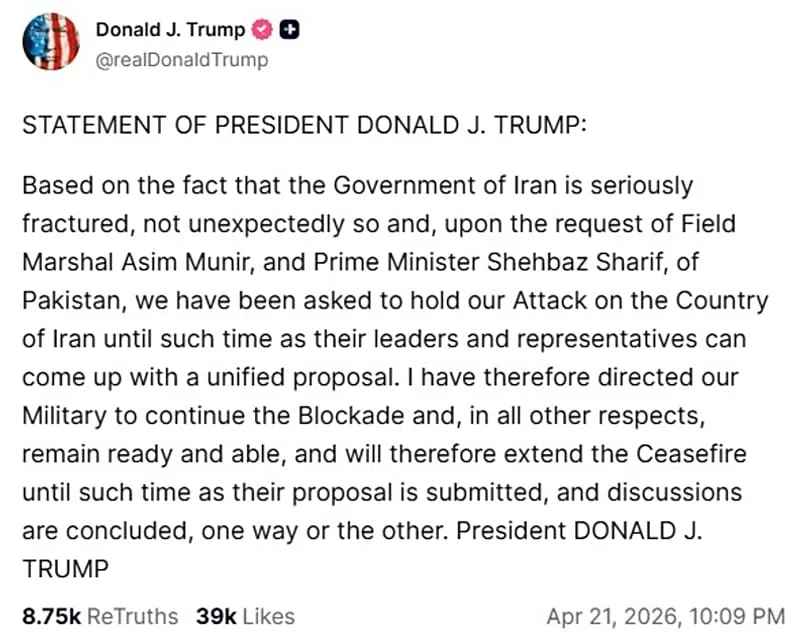
U.S. President Donald Trump has agreed to extend an existing ceasefire with Iran indefinitely, citing a request from Pakistan's prime minister and top military official as the basis for the decision, according to reporting by Euronews.
The extension was granted as Pakistan works to arrange a second round of high-level negotiations between Washington and Tehran, building on earlier diplomatic contacts that Islamabad has helped facilitate.
Trump confirmed the decision publicly, framing it as a response to direct outreach from Pakistani leadership. The move signals continued U.S. willingness to pursue a diplomatic resolution over military pressure, at least while backchannel efforts remain active.

Pakistan's mediating role
Pakistan has positioned itself as a key intermediary in what has become one of the most closely watched diplomatic tracks in the region. The country's prime minister and senior military figures have been in contact with both American and Iranian officials as part of efforts to keep negotiations on track.
The decision to grant an indefinite extension - rather than a time-limited pause - suggests a degree of confidence from Washington that the diplomatic process has enough momentum to justify continued restraint.
Background to the talks
The ceasefire and associated talks come amid longstanding tensions over Iran's nuclear program, which has been a central point of conflict between Tehran and Western governments for more than two decades. Previous diplomatic frameworks, including the 2015 Joint Comprehensive Plan of Action, collapsed after the United States withdrew under Trump's first term in office.
A second round of direct U.S.-Iran talks would mark a significant development in efforts to reach a new agreement. Details of what was discussed in the first round, and what any potential deal might involve, have not been fully disclosed publicly.
Significance of the extension
By agreeing to an open-ended pause rather than setting a firm deadline, the Trump administration is leaving room for negotiations to proceed without an artificial pressure point. At the same time, analysts have noted that indefinite extensions can lose their deterrent value if the underlying talks stall or break down.
Iran has not publicly commented on the extension, according to available reporting. The full scope of Tehran's conditions for continuing talks remains unclear.
Pakistan's involvement underscores its ongoing effort to maintain influence in regional diplomacy at a time when it faces its own domestic and economic pressures. Islamabad has historically sought to balance relationships with major powers, including the United States, China, and Gulf states.