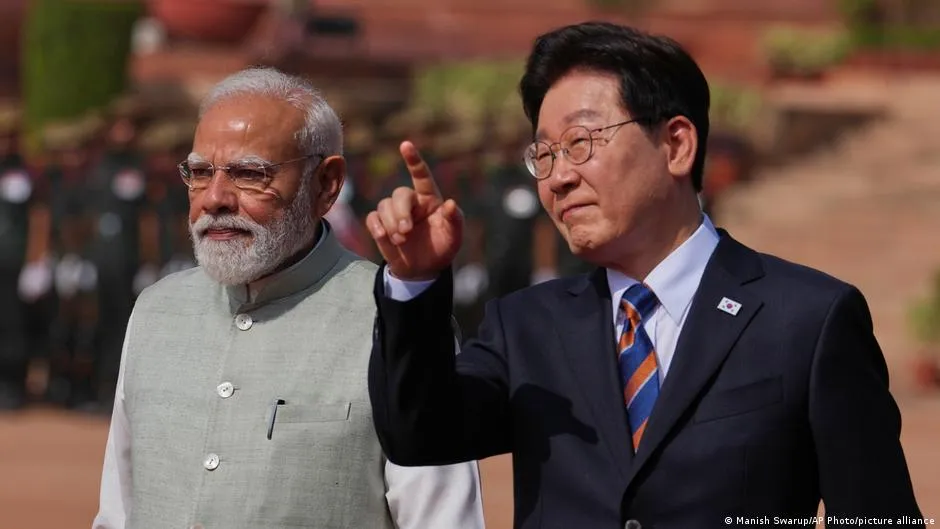
In a world where trade wars are basically the new contact sport, India and South Korea are doing something refreshingly old-school: actually trying to trade more with each other. Prime Minister Narendra Modi hosted South Korean President Lee Jae Myung this week, and the two leaders emerged with a shared ambition - hitting $50 billion in bilateral trade by 2030, according to Deutsche Welle.
That is not nothing. To put it in context, it means two of Asia's most significant industrial powerhouses are betting on each other at a time when most countries are hedging bets, building walls, and stress-eating tariffs for breakfast.
Why now, why each other?
The timing is not exactly a coincidence. Global supply chains are getting reshuffled faster than a Vegas card deck, and both India and South Korea have strong incentives to diversify their economic partnerships. India brings a massive and growing consumer market, a booming tech and manufacturing sector, and Modi's well-publicised "Make in India" ambitions. South Korea brings semiconductor muscle, automotive expertise, and companies like Samsung and Hyundai that already have serious skin in the India game.
For Seoul, deepening ties with New Delhi is part of a broader strategy to reduce over-reliance on China - a theme that has become something of a geopolitical earworm across Asia. For India, South Korean investment and technology access fits neatly into its industrial upgrade plans.
The diplomatic backdrop
The summit comes amid what DW describes as "global tensions" - which is doing a lot of heavy lifting as a phrase in 2025, but broadly refers to ongoing US-China friction, regional security pressures, and the general vibe of uncertainty hanging over international trade. In that climate, bilateral agreements between mid-to-large powers are quietly becoming more valuable.
Both countries are also part of overlapping regional frameworks, which gives the relationship structural legs beyond just the goodwill of two leaders shaking hands in front of cameras.
The $50 billion question
The target is ambitious but not absurd. Current bilateral trade sits at a fraction of that goal, meaning both sides would need to significantly accelerate momentum. The details of how - specific sectors, investment pledges, or updated free trade agreement terms - were not fully laid out in early reporting, so the real work is presumably still being done by people in smaller rooms with worse lighting.
Still, as geopolitical alignments continue to shift, a Seoul-New Delhi economic axis is exactly the kind of thing that could quietly matter quite a lot over the next decade.