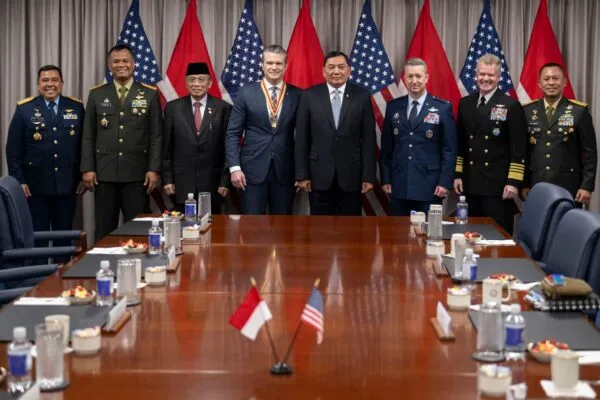
The United States and Indonesia have announced a broadened defense partnership, even as Indonesian President Prabowo Subianto conducts a visit to Russia, signaling that Jakarta intends to maintain its tradition of non-alignment despite growing pressure from major powers, according to reporting by The Diplomat.
Washington and Jakarta pledged to expand and deepen bilateral security cooperation, a move that reflects growing U.S. interest in Southeast Asia amid heightened geopolitical competition with China. The announcement positions Indonesia as an increasingly important partner for American strategic interests in the region.
However, Prabowo's simultaneous engagement with Moscow underscores the limits of that partnership. Indonesia has historically pursued an independent foreign policy, refusing to formally align itself with any major power bloc - a posture rooted in the country's founding principle of bebas dan aktif, meaning "free and active" in international affairs.
Balancing act
Indonesia's outreach to both Washington and Moscow in close succession reflects a calculated diplomatic balancing act. By engaging multiple great powers, Jakarta seeks to preserve its strategic autonomy while extracting economic and security benefits from each relationship.
Analysts cited by The Diplomat suggest that the new U.S.-Indonesia defense partnership is unlikely to fundamentally alter Indonesia's foreign policy orientation. Despite the stronger ties with Washington, Jakarta is not expected to distance itself from Russia, China, or other powers with which it maintains substantive relationships.
Indonesia is the world's fourth most populous country and the largest economy in Southeast Asia, making its alignment - or deliberate non-alignment - a matter of significant consequence for regional power dynamics. The country also holds the rotating chair of ASEAN at various intervals, amplifying its diplomatic influence.
Regional context
The defense announcement comes as Washington works to strengthen partnerships across the Indo-Pacific in response to China's growing military and economic footprint. Several Southeast Asian nations have similarly sought to deepen ties with the United States while maintaining working relationships with Beijing and, in some cases, Moscow.
Prabowo, who took office in October 2024, has signaled an intention to maintain the independent foreign policy course charted by his predecessors, including former President Joko Widodo. His administration has continued engaging with a broad range of international partners rather than anchoring Indonesia firmly in any single orbit.
The details of the new U.S.-Indonesia defense partnership, including specific agreements on military cooperation, equipment sales, or joint exercises, were not fully outlined in the available reporting.