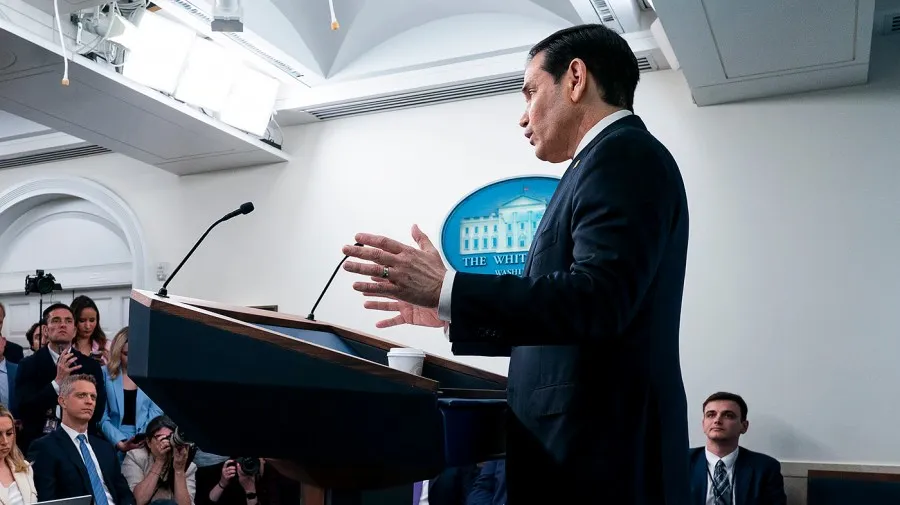
Secretary of State Marco Rubio on Tuesday declared the War Powers Act to be unconstitutional, while acknowledging the Trump administration is selectively complying with the law as a diplomatic gesture toward Congress rather than out of legal obligation.
"The War Powers Act is unconstitutional, 100 percent," Rubio told reporters at a White House briefing, according to The Hill. He stated that the administration is adhering only to certain "elements" of the law in order to maintain working relationships with lawmakers on Capitol Hill.
Rubio indicated his view is not unique, noting that opposition to the law has been expressed by others across the political spectrum and within prior administrations.
What the War Powers Act requires
The War Powers Resolution, passed by Congress in 1973 over President Richard Nixon's veto, requires the president to notify Congress within 48 hours of committing U.S. armed forces to military action abroad. It also limits unauthorized military engagements to 60 days without congressional approval, with an additional 30-day withdrawal period.
The law was designed to check the executive branch's ability to engage in prolonged military conflicts without a formal declaration of war from Congress, which holds that authority under the Constitution.
A longstanding executive branch tension
Rubio's comments reflect a position that multiple administrations - from both parties - have held in practice, even if rarely stated so directly. Presidents have routinely conducted military operations while disputing whether the War Powers Act legally applied to their actions, without formally conceding the law's constitutionality.
No president has ever fully embraced the statute as a binding constraint, and the law has never been definitively tested before the Supreme Court, leaving its constitutional status unresolved in the courts.
The Trump administration's position, as articulated by Rubio, goes a step further by explicitly labeling the law unconstitutional while still choosing to engage with Congress on a voluntary basis.
Congressional implications
The remarks carry potential significance for any future military actions the administration might undertake. By framing compliance as optional and rooted in political goodwill rather than legal duty, the administration is signaling it views presidential war-making authority as largely unconstrained by the 1973 resolution.
Congressional critics of expansive executive power have long warned that erosion of the War Powers Act could leave legislators with limited ability to check military commitments made without their approval.