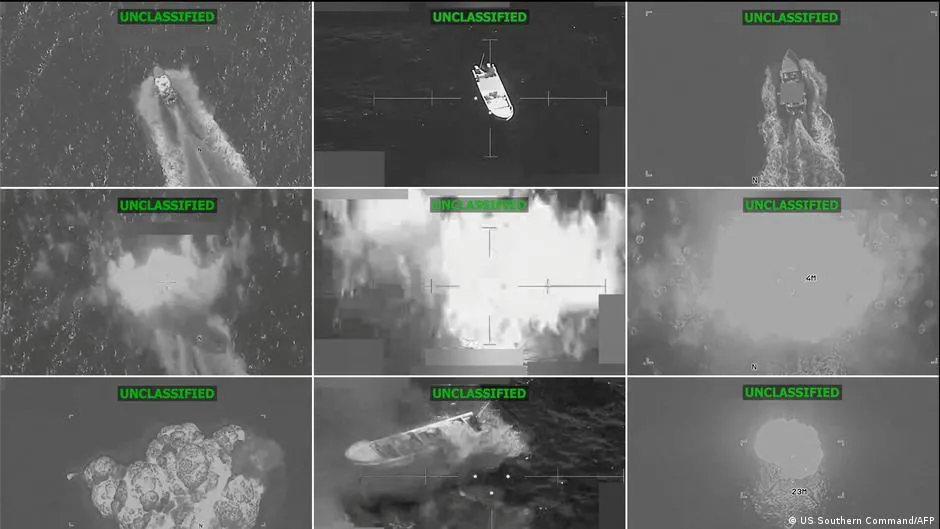
The United States has conducted additional military strikes on vessels suspected of drug trafficking, according to reporting by Deutsche Welle, an operation that has triggered a growing legal and strategic debate among analysts and officials.
The strikes, carried out as part of a broader Trump administration push to use military force against drug supply chains, have drawn criticism on two fronts: whether they are legally justified under international and domestic law, and whether they achieve any measurable reduction in drug flows into the United States.
Legal questions mount
Legal scholars and critics have raised concerns about the authority under which the strikes are being conducted. Questions center on whether attacking vessels in international or foreign waters constitutes an act of war, and what legal framework permits the use of lethal military force against suspected smugglers who have not been convicted of any crime.
The use of military assets in what has traditionally been a law enforcement domain adds a layer of constitutional complexity, with some legal observers arguing the operations may require congressional authorization that has not been sought or granted.
Effectiveness disputed
Beyond the legal controversy, critics have questioned whether the strikes accomplish their stated counternarcotics objectives. Drug trafficking networks are widely described by analysts as adaptable, with the destruction of individual vessels unlikely to disrupt supply chains in any sustained way.
According to DW's reporting, some critics have argued the operations are less about reducing drug trafficking and more about projecting a tough-on-drugs image to Trump's domestic political base, serving as a visible symbol of action rather than a strategic counternarcotics tool.
Administration's position
The Trump administration has framed the strikes as a necessary escalation in the fight against drug cartels, which it has designated as foreign terrorist organizations. Officials have pointed to drug-related deaths in the United States, particularly those linked to fentanyl, as justification for aggressive interdiction measures.
The administration has argued that treating drug trafficking as a national security threat, rather than purely a law enforcement matter, warrants the use of military force.
The debate reflects a broader tension in US drug policy between enforcement-heavy approaches and those focused on demand reduction and diplomatic cooperation with source and transit countries. As further strikes are reported, legal and policy scrutiny is expected to intensify both domestically and internationally.