If you thought your hometown was old, try this on for size: astronomers have spotted a galaxy that was already doing its thing a mere 800 million years after the Big Bang - and according to reporting by Ars Technica, it is already packed with heavy elements forged in the universe's very first supernovae. Humbling stuff.
Cosmic zoom lens to the rescue
The trick that made this observation possible is a phenomenon called gravitational lensing - essentially, a massive foreground object (like a galaxy cluster) bends light from something far behind it, acting as a natural magnifying glass. Think of it as the universe lending us a giant pair of spectacles so we can squint at things that are almost incomprehensibly far away.
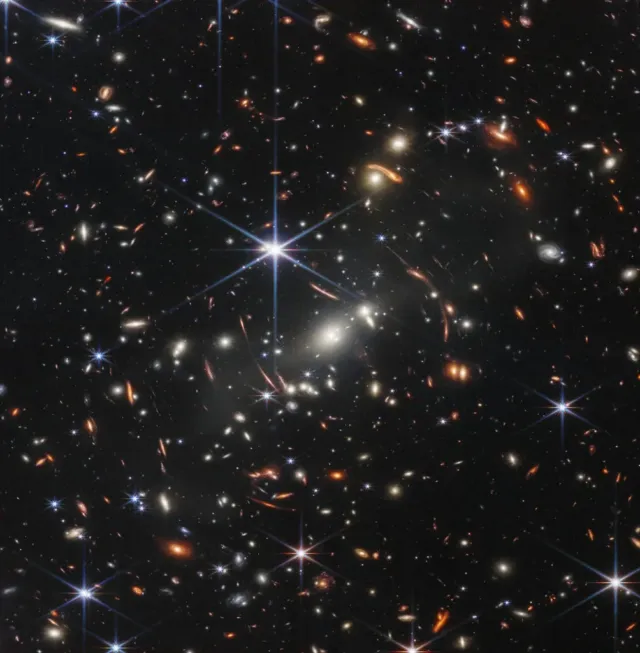
Without this cosmic cheat code, a galaxy this distant and this early in cosmic history would be essentially invisible to us, no matter how fancy our telescopes are.
First-generation supernova leftovers, anyone?
Here is where things get genuinely fascinating. The galaxy is not just old - it is chemically interesting. Researchers found that it contains elements that could only have been produced by the universe's first generation of supernovae, sometimes called Population III stars. These were enormous, fast-living, and fast-dying stellar beasts that seeded the cosmos with heavier elements for the first time.

Finding those chemical fingerprints in such an early galaxy is like discovering a medieval manuscript that references an even older, lost text - it is evidence of something we have never directly observed, pointing backward through time.
Why this matters (and it really does)
One of the big open questions in cosmology is exactly how and when the universe's earliest structures formed, how quickly they evolved, and what the very first stars were like. Each observation like this one chips away at that mystery.

It also raises more questions than it answers - which, honestly, is the scientific tradition. How did this galaxy accumulate heavy elements so quickly? What were those first supernovae actually like? How many more of these ancient, chemically evolved galaxies are hiding behind gravitational lenses, waiting to be found?
The universe, it turns out, was not wasting any time. Eight hundred million years post-Big Bang and galaxies were already cooking up complex chemistry. Meanwhile, it takes humans at least 25 years to figure out how to do laundry.
Full details on the observation are available via Ars Technica.