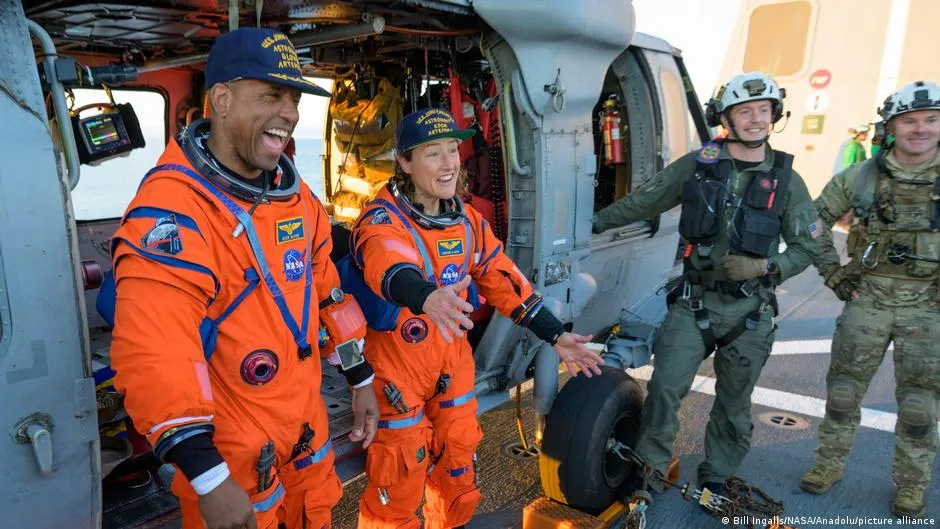
In what is objectively the coolest commute home ever attempted, the four crew members of NASA's Artemis II mission are preparing to slam back into Earth's atmosphere and cannonball into the Pacific Ocean off the California coast - and yes, that is the plan, not a malfunction.
So what actually happened here?
According to reporting by DW, the Artemis II astronauts are in the final stages of their return journey, bracing for reentry into Earth's atmosphere before their capsule splashes down in the Pacific. This marks a major milestone for NASA's Artemis program, which has been working to return humans to the Moon for what feels like approximately one geological era.
Artemis II was a crewed test flight around the Moon - not a landing, but a critical shakedown cruise for the Orion spacecraft and Space Launch System. Think of it as NASA taking the car around the block before attempting a cross-country road trip, except the block is 400,000 kilometers wide and the car costs several billion dollars.
Who's in the capsule?
The crew consists of NASA astronauts Reid Wiseman, Victor Glover, and Christina Koch, along with Canadian Space Agency astronaut Jeremy Hansen - making Hansen the first Canadian to travel beyond low Earth orbit. Canada, always polite, sent exactly one person to represent the entire country in deep space. Respect.
Why does the splashdown matter?
Reentry is genuinely one of the most harrowing parts of spaceflight. The Orion capsule hits the atmosphere at roughly 40,000 kilometers per hour, creating a plasma fireball around the vehicle that briefly cuts off communication with ground controllers. Astronauts call this the "blackout period." Everyone else calls it "the part where we nervously stare at screens."
A successful splashdown would validate Orion's heat shield and recovery systems ahead of Artemis III, which is planned to actually land humans on the lunar surface - including the first woman and first person of color to walk on the Moon.
The bigger picture
Artemis II represents the first time humans have traveled beyond low Earth orbit since Apollo 17 in 1972. More than half a century later, the species that invented reality television has also managed to keep its Moon ambitions alive. Progress comes in many forms.
DW is providing live coverage of the splashdown event as it unfolds.