
Virginia Democrats just scored a significant victory in what is shaping up to be one of the most fiercely contested battlegrounds in modern American politics - not a battlefield with guns, but with rulers, census data, and very aggressive cartographers.
According to Al Jazeera, Democrats came out on top in Virginia's redistricting election, a result that carries implications well beyond the state's borders. The vote is part of a broader, ongoing national tug-of-war between Democrats and Republicans over the practice of gerrymandering - the fine art of drawing district lines so creatively that your opponents might as well run their candidates in the middle of the Atlantic Ocean.

So what actually happened?
Virginia held a vote tied to its redistricting process, and Democrats emerged as the winners. The result gives the party significant leverage over how congressional and state legislative district boundaries are drawn - boundaries that will directly influence election outcomes for years to come. In American politics, controlling the map is often just as important as winning the votes drawn on it.
Why this matters beyond Virginia
This isn't just a local story. Redistricting fights are happening across the United States as both parties maneuver to lock in favorable electoral geography ahead of future election cycles. Democrats have framed their push as a fight against partisan gerrymandering, while Republicans have largely used redistricting power in states they control to consolidate their own advantages - a habit both parties have historically been guilty of, depending on who holds the pen.
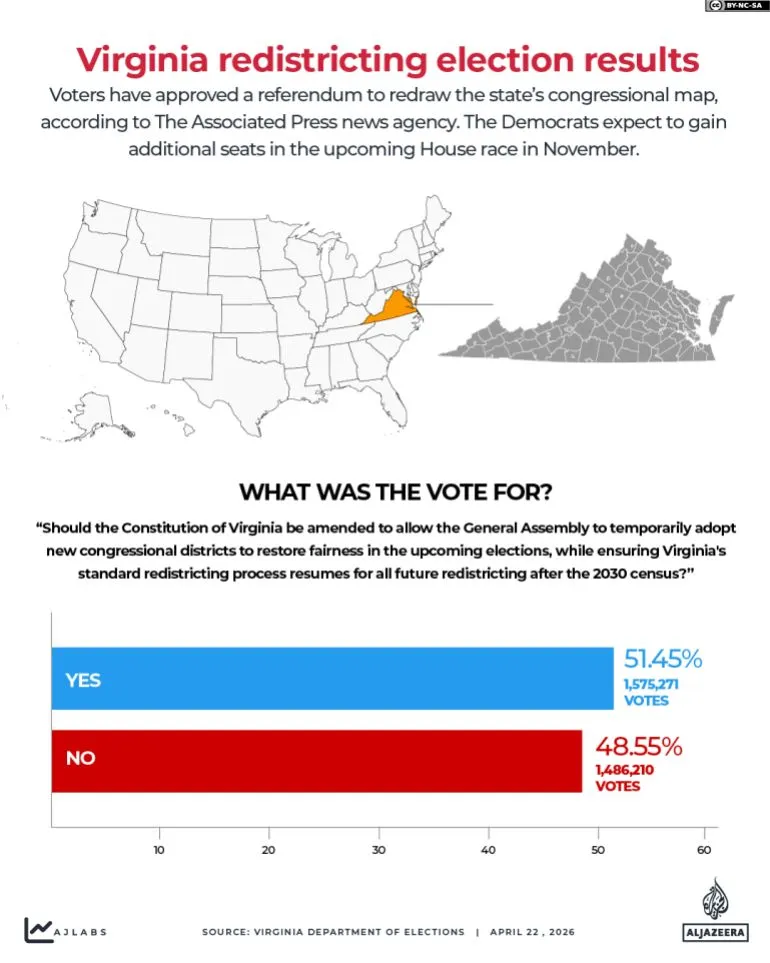
Virginia's outcome adds momentum to Democratic efforts nationally, signaling that voters in at least one key swing state are paying attention to who draws the lines and why.
The bigger picture
Gerrymandering has become one of the more quietly explosive issues in American democracy. It rarely dominates cable news the way a presidential tweet does, but its effects are profound - shaping which voices get amplified in Congress and which communities get conveniently carved up into political irrelevance.
The Virginia result, as reported by Al Jazeera, is one data point in a much larger national contest that will continue playing out state by state, courtroom by courtroom, and election by election. Democrats will claim this as proof the strategy works. Republicans will regroup and sharpen their own compasses.
Either way, the maps are being redrawn. And in American politics, that is sometimes more powerful than any single election.