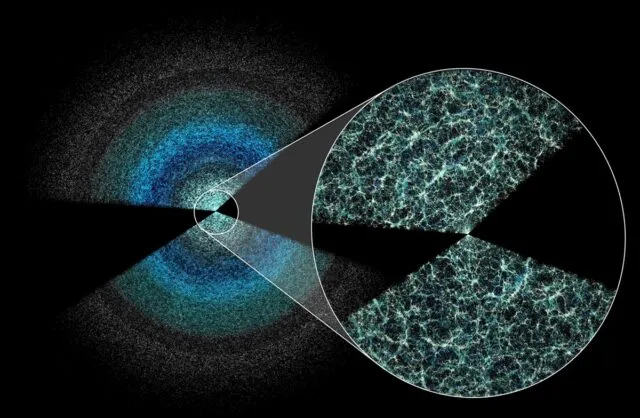
The Dark Energy Spectroscopic Instrument (DESI) has successfully completed its ambitious three-dimensional mapping of the universe, finishing the project on schedule, according to a report by Ars Technica.
The survey, which catalogued the positions and distances of millions of galaxies across vast stretches of the cosmos, represents one of the most detailed large-scale maps of the universe ever produced.

What the data could reveal
While scientists have confirmed the map's completion, the collected data still requires extensive analysis before conclusions can be drawn. Researchers say the results could prove significant in addressing one of modern physics' most pressing open questions: whether dark energy - the mysterious force believed to be driving the accelerating expansion of the universe - remains constant over time or fluctuates.
Dark energy is thought to account for roughly 68 percent of the total energy content of the universe, yet its fundamental nature remains poorly understood. Current cosmological models, based on what is known as the cosmological constant, assume dark energy is fixed and uniform. Evidence that it changes over time would require a substantial revision of those models.
A project years in the making
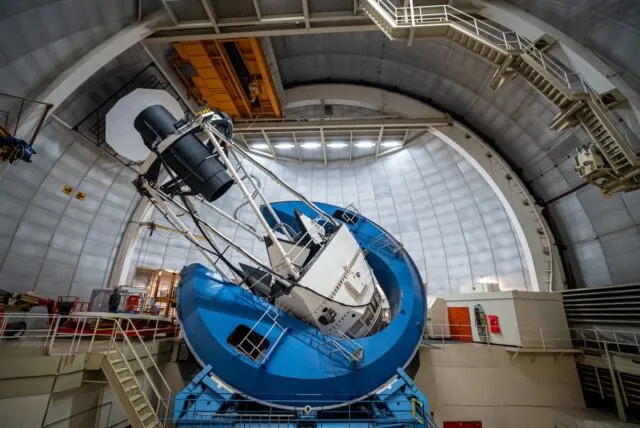
DESI, located at the Kitt Peak National Observatory in Arizona, uses an array of 5,000 fiber-optic sensors to capture the light spectra of galaxies simultaneously, allowing scientists to measure their distances and map how matter is distributed across the universe in three dimensions.
The instrument began its primary survey in 2021 and was designed to observe tens of millions of galaxies and quasars. Completing the survey on its planned timeline is considered a significant operational achievement for the collaboration behind the project, which involves hundreds of researchers from institutions around the world.
Next steps
Scientists involved in the project will now turn their full attention to processing and analyzing the completed dataset. Previous early data releases from DESI had already generated discussion in the scientific community, with some preliminary results hinting at possible variations in dark energy - findings that were regarded as tentative pending a fuller dataset.
The completed map is expected to provide far stronger statistical evidence either supporting or challenging those earlier signals. Researchers have not yet indicated a timeline for when major scientific results from the full dataset will be published.
The project's completion marks a milestone for observational cosmology, and the forthcoming analysis is anticipated to be closely watched by physicists and astronomers worldwide.