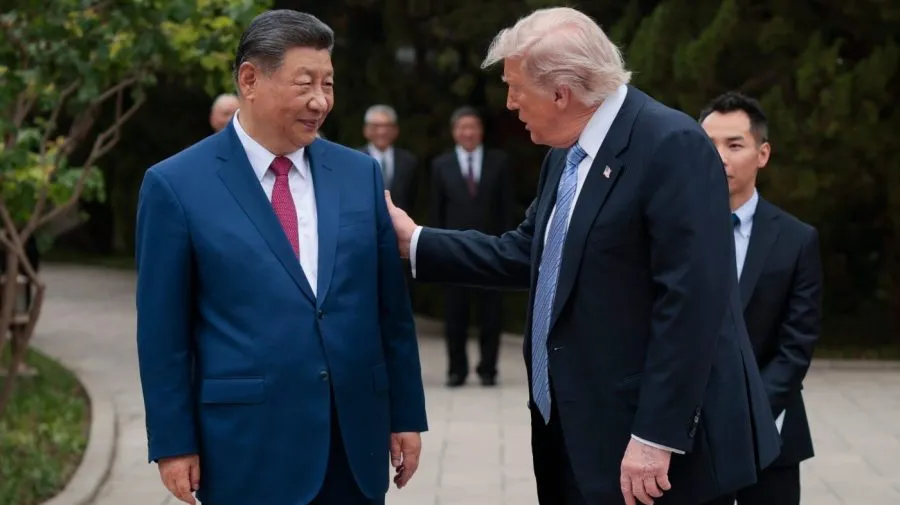
In what may be the most diplomatically vague breakthrough of the century, President Donald Trump revealed Friday that he and Chinese President Xi Jinping had a conversation about possibly, maybe, potentially working together on artificial intelligence safety guardrails. Hold your applause.
Speaking to reporters aboard Air Force One following his summit with Xi in China, Trump said the two leaders "talked about possibly working together for guardrails" on AI, according to The Hill. Not a treaty. Not a framework. Not even a handshake deal. A conversation about possibly working together. The robots are definitely quaking.
Why this actually matters, jokes aside
Okay, here is the thing - despite the delightfully non-committal phrasing, this is genuinely significant. The United States and China are the two dominant players in the global AI race, and the idea that their leaders are even floating the concept of coordinated safety measures is more than nothing. In Washington, policymakers are currently wrestling with how to regulate AI without strangling innovation, and having China at any version of that table changes the calculus considerably.
AI guardrails typically refer to safety measures designed to prevent artificial intelligence systems from being used for catastrophic purposes - think autonomous weapons, large-scale disinformation campaigns, or systems that could destabilize critical infrastructure. These are not small concerns.
The geopolitical context is... complicated
The timing of this disclosure is worth noting. US-China relations have been a rollercoaster of tariffs, tech export controls, and military posturing. Washington has spent considerable energy trying to limit China's access to advanced semiconductor chips specifically to slow its AI development. So the idea of simultaneously competing with and cooperating with Beijing on AI safety is the diplomatic equivalent of racing someone in a car while also offering to help them install seatbelts.
Critics will likely argue that any cooperation with China on AI could inadvertently share sensitive technical knowledge. Supporters will counter that a world where two superpowers develop powerful AI systems in complete isolation from each other, with zero shared safety norms, is considerably more terrifying.
So what happens next?
That part remains deeply unclear. Trump's remarks were light on specifics, and no formal agreement, working group, or timeline was announced. What we have is a presidential statement that a conversation happened, and that the word "possibly" featured prominently.
But in a geopolitical climate where the US and China agreeing on lunch would be newsworthy, two heads of state at least acknowledging that runaway AI might be a shared problem is a start - however tentative, however vague, and however entertainingly hedged.